Choosing a hair trimmer manufacturer is not simply a matter of comparing quotations. The right partner should be able to translate your market idea into a coherent, manufacturable product—and support that product as your brand grows.
For brand owners, the best evaluation method is evidence-based: define what you need, ask every candidate the same questions, and verify each answer with documents, samples, test records, or an on-site assessment. The following nine criteria provide a practical starting point.
A strong supplier should ask about your target user before recommending a product. A barber-grade clipper, a home haircut kit, and a compact travel trimmer require different decisions about motor performance, blade geometry, battery capacity, accessories, noise, and price positioning.
Ask the manufacturer to explain:
Production capacity matters, but it does not prove that a supplier can solve development problems. Ask who is responsible for product definition, industrial design, mechanical engineering, electronics, packaging, and project coordination.
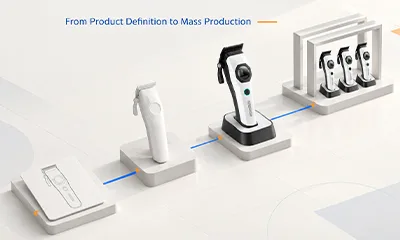
The manufacturer should be able to show a clear path from concept to specification, prototype, validation, and mass production. Ask for current project evidence—such as development records, approved samples, or documented review gates—rather than relying on unsupported claims.
A trimmer is a system, not a collection of independent components. Motor torque affects cutting performance. Blade material and geometry affect comfort, durability, and noise. Battery selection affects runtime, charging time, housing design, and target-market compliance.
The terms OEM and ODM are often used loosely. Before starting, define who owns each part of the work: product concept, industrial design, tooling, electronics, packaging, compliance files, and future design changes.
Also confirm how intellectual property, drawings, molds, and exclusive elements will be handled. Put these responsibilities into the project documentation. A reliable hair trimmer manufacturer should make ownership and approval points clear before development costs are committed.
A prototype that looks good is not automatically ready for production. Ask the supplier to describe the approval stages it uses and what evidence is produced at each stage.
A practical process should distinguish among appearance review, functional validation, engineering confirmation, packaging approval, and final pre-production sign-off. Because sampling and tooling cycles vary by design complexity, component availability, and validation requirements, avoid accepting a universal timeline without a project-specific review.
Certificates are useful, but they should not replace product-level evidence. UTRUST has confirmed that it has passed an amfori BSCI audit and holds ISO 9001 certification. ISO describes ISO 9001 as a quality-management standard focused on consistent processes and meeting customer expectations. amfori describes BSCI as a solution for identifying, assessing, verifying, and mitigating social risks in supply chains.
During qualification, ask to see current documentation and clarify its scope. Then review how the supplier controls incoming materials, in-process production, final inspection, non-conforming products, corrective actions, and changes to approved components.
Useful references include the official ISO 9001 standard page and the official amfori BSCI overview.
Compliance should be planned during product definition—not added at the end. Requirements can vary with the target country, power system, battery, charger, materials, wireless functions, and intended use.
A low quotation may exclude tooling, packaging development, testing, spare parts, or change costs. Likewise, MOQ and lead time depend on the level of customization and the availability of components.
Request a written commercial breakdown covering:
The strongest signal often appears before the order. Does the supplier identify risks early? Does it explain alternatives? Are commercial, product, technical, and delivery decisions coordinated?
UTRUST uses a 4D Advisory Service that brings together Sales, Product, Technology, and Delivery perspectives. The purpose is not merely to ship a single SKU, but to help brand clients develop recognizable, scalable product lines.
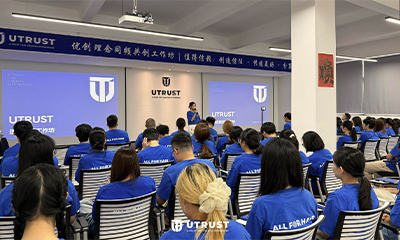
Founded in Ningbo in 2014, UTRUST focuses on hair care electrical appliances. According to its company information, its products reach more than 70 countries and regions, it holds over 100 patents, has served more than 200 brand clients, and delivers more than 8 million units annually.
The best hair trimmer manufacturer is not necessarily the supplier with the longest catalog or the lowest initial price. It is the partner that can explain its decisions, show evidence, manage risk transparently, and support your product beyond the first shipment.
If you are planning a new hair trimmer or a coordinated grooming product line, contact UTRUST at info@cn-utrust.com. Share your target market, user group, product positioning, and launch goals so the team can evaluate the project on its actual requirements.
Start with your target user, market, price position, product concept, and launch objective. Then ask how the supplier would convert those inputs into a validated specification.
No. It is a useful quality-management signal, but buyers should also review its current scope and verify product-level controls, records, samples, and corrective-action processes.
Choose based on how much product definition and design you already own. More important than the label is a written division of responsibility for design, tooling, testing, compliance, packaging, and future changes.
Give each candidate the same product brief and ask for the same cost breakdown. Compare included specifications, tooling, testing, packaging, MOQ, lead time, and change conditions—not unit price alone.
Provide the destination market, user group, target price segment, expected functions, preferred appearance, planned sales channel, packaging needs, estimated quantity, and target launch window.